
Crochet is a wonderfully accessible craft that allows beginners to create beautiful projects with just a few simple stitches. Whether you want to make blankets, scarves, bags, garments, or decorative items, all crochet creativity starts with understanding the basic stitches. Many patterns use the same foundational techniques repeatedly, which means learning a small set of stitches opens the door to thousands of possibilities. This guide introduces the most beginner-friendly crochet stitches and explains how each one works, how to identify them, and where they are commonly used.
Getting Started: Hook, Yarn, and Tension
Before diving into individual stitches, it is important to understand the basics of handling your yarn and hook. Choose a smooth, medium-weight yarn (often labeled as worsted weight or category 4) and a hook size recommended on the yarn label. Beginners usually find ergonomic hooks easier to control.
Hold the hook comfortably—there is no right or wrong way, only what feels natural to you. Maintain gentle but steady tension on the yarn. Too much tension makes the stitches tight and difficult to work, while too little tension creates loose and uneven stitches. With practice, your tension becomes consistent, which is crucial for clean, beautiful crochet.
Chain Stitch (ch)
The chain stitch is the foundation of almost every crochet project. It forms the base row where all other stitches are built. To make a chain, you simply wrap the yarn over the hook and pull it through the loop. The stitches resemble a thin braided cord.
Chains are used to start blankets, scarves, bags, and garments. They also create spaces in lace patterns and serve as turning chains when moving to a new row. Practice making even chains—they are the first step toward smooth, consistent work.
Slip Stitch (sl st)
The slip stitch is the smallest and tightest stitch in crochet. To make one, insert your hook into the stitch, yarn over, and pull through both loops at once. Slip stitches are essential for joining rounds, moving across stitches without adding height, and creating decorative surface details.
Slip stitch patterns can create dense, beautiful textures, though they require extra patience. Beginners often use slip stitches to join granny squares or finish the tops of bags and garments.
Single Crochet (sc)
Single crochet is one of the most fundamental stitches in crochet. It creates a dense, sturdy fabric that is perfect for blankets, toys, bags, and dishcloths. To make a single crochet, insert your hook into the stitch, yarn over, pull up a loop, yarn over again, and pull through both loops.
Single crochet stitches stack closely, providing excellent structure. This is why they are commonly used in amigurumi, where tight stitches prevent stuffing from showing through. They are also ideal for beginners because they help develop good control and spacing.
Half Double Crochet (hdc)
The half double crochet stitch is slightly taller than single crochet but shorter than double crochet. It creates a plush, smooth texture that drapes well. To make a half double crochet, yarn over before inserting your hook, pull up a loop, then yarn over and pull through all three loops at once.
HDC is a favorite stitch for baby blankets, scarves, sweaters, and pillows. It works up quickly while remaining dense enough for warmth. Many modern crochet patterns rely on half double crochet because of its balance between height and structure.
Double Crochet (dc)
Double crochet is tall, airy, and one of the fastest stitches to work. To create a double crochet, yarn over, insert your hook, pull up a loop, yarn over, pull through two loops, then yarn over and pull through the final two loops.
Because double crochet stitches are tall, they create flexible, drapey fabric. They are used in blankets, garments, shawls, and lacy patterns. Double crochet is also the foundation for many textured stitches such as shells, v-stitches, and clusters.
Treble Crochet (tr)
Treble crochet, also called triple crochet, is even taller than double crochet. To make a treble stitch, yarn over twice, insert your hook, pull up a loop, yarn over, pull through two loops, yarn over, pull through two loops, and repeat one more time.
Treble stitches create very open, lacy fabric, making them great for scarves, beachwear, and decorative throws. Although not as common in beginner patterns, they help broaden your skills and add variety to your projects.
Moss Stitch (Linen Stitch)
The moss stitch is one of the easiest textured stitches and produces a woven look. It alternates single crochet stitches and chain spaces. The result is a flat, dense fabric with tiny gaps that give it visual interest.
This stitch is ideal for beginners because it is simple, rhythmic, and forgiving. Moss stitch is widely used for blankets, scarves, dishcloths, and home décor. It also works beautifully with variegated yarns since the alternating pattern prevents color pooling.
Granny Stitch
The granny stitch forms the classic clusters seen in traditional granny squares. A granny cluster is made of three double crochet stitches worked into the same space. These clusters are placed in chain spaces rather than individual stitches, making the pattern very easy to memorize.
Granny stitch is perfect for beginners because it grows quickly and allows you to practice color changes. You can use it to make blankets, scarves, pillows, bags, and, of course, the iconic granny square.
Shell Stitch
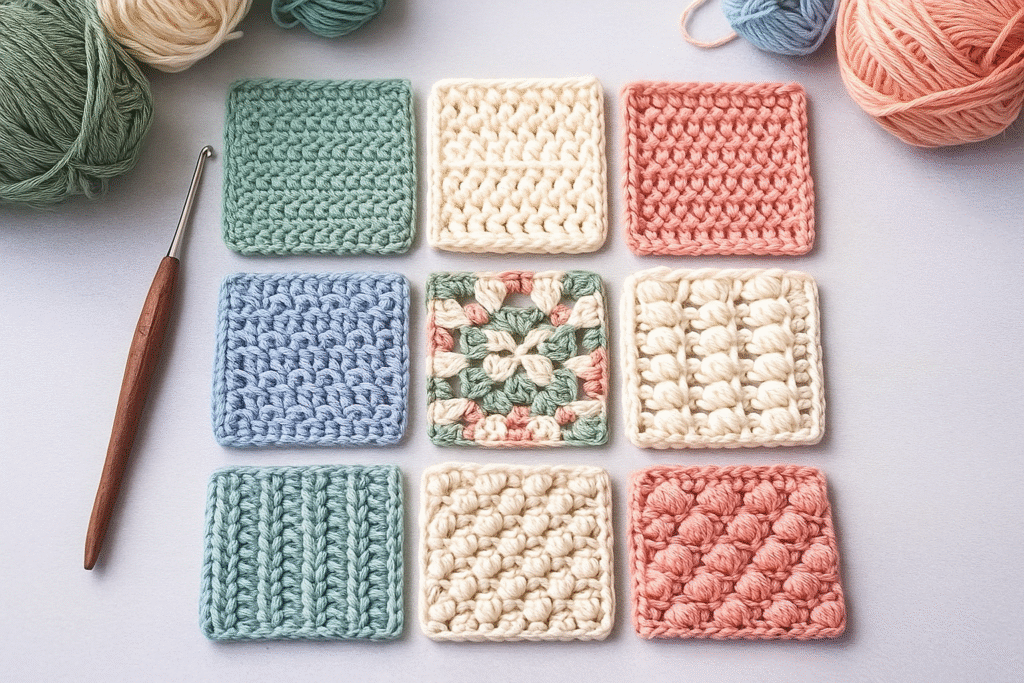
Shell stitch creates elegant scalloped designs using groups of multiple stitches—usually double crochets—in the same space. Shells form a wave-like appearance that adds texture and beauty to blankets and garments.
Beginners enjoy shell stitch because it looks impressive without being complicated. When worked in soft pastel colors, shell stitch is especially lovely for baby blankets or delicate accessories.
V-Stitch
The v-stitch is formed by working two double crochet stitches into the same stitch with a chain in between, creating a “V” shape. This stitch creates excellent drape and is ideal for airy blankets, shawls, and open cardigans.
V-stitch is beginner-friendly and quick to work. It is also extremely versatile—changing the yarn weight or hook size can completely transform the look.
Puff Stitch
Puff stitches create thick, decorative bumps that add soft texture to any project. To make a puff stitch, pull up multiple loops in the same stitch, then yarn over and pull through all loops at once. The puff stitch adds charm to baby blankets, hats, and pillows.
Puff stitches require good tension control, but beginners can learn them with practice. They look especially beautiful in solid-colored yarns, where the texture stands out clearly.
Ribbing with Front and Back Post Stitches
Front post double crochet (FPDC) and back post double crochet (BPDC) stitches shift where the hook enters the stitch, creating raised ridges similar to knitted ribbing. These stitches are used for:
Hat brims
Sweater cuffs
Blanket edges
Bag straps
Although slightly more advanced, they are worth learning early because they appear in many patterns and add stretch and structure.
Cluster Stitches
Cluster stitches involve partially completing multiple stitches before joining them at the top. They create decorative textures and appear in many modern patterns. Clusters can be made with double crochet, treble crochet, or puff-like variations.
Cluster stitches are excellent for creating floral motifs, geometric patterns, or repeating textured designs for blankets and home décor.
Tips for Learning and Improving Your Crochet Stitches
Here are some tips to help beginners develop skill and confidence:
Practice stitches in swatches before starting a project.
Focus on maintaining even tension.
Count stitches frequently to avoid accidental increases or decreases.
Use stitch markers to identify the beginning or end of rows.
Choose smooth, light-colored yarn so you can see your stitches clearly.
Crochet becomes much easier with practice. Over time, your hands will memorize the movements, and your stitches will become consistent and beautiful.
Final Thoughts
Learning beginner-friendly crochet stitches unlocks endless creative opportunities. From basic stitches like single crochet and double crochet to textured patterns like moss stitch and shell stitch, each technique adds something special to your projects. As you become more comfortable with these stitches, you will feel more confident exploring new patterns and designing your own creations. With patience and enthusiasm, you will soon be making beautiful handmade items that showcase your skills and creativity.